If you’re planning a new timber deck, one of the first decisions you’ll need to make is what material to use.
A quick search for the best timber for decking in Sydney can leave you with a long list of options, opinions and comparisons.
But there isn’t one timber that is automatically the best choice for every deck.
The right material depends on your property, where the deck will be built, how exposed it is to the weather, the appearance you want, the amount of maintenance you’re comfortable with and your overall project budget.
Timber durability is also influenced by more than the species alone. Moisture, fungi, termites, ultraviolet exposure, construction detailing and ongoing maintenance can all affect how external timber performs over time.
So before choosing your decking based purely on colour or price, it helps to look at the bigger picture.
There Isn’t One “Best” Timber for Every Deck
When homeowners ask what the best decking timber is, the most useful answer often starts with another question:
Best for what?
The best material for a heavily exposed deck may be different from the best choice for a protected outdoor entertaining area.
One homeowner may want a particular natural appearance and be happy to maintain it regularly.
Another may prioritise durability and practicality.
Someone else may be working within a specific budget.
That’s why choosing outdoor decking timber should involve more than comparing a few sample boards.
The material needs to suit the way the finished deck will actually be used.
1. Think About the Appearance You Want
Your deck is usually a significant visual part of the outdoor area, so appearance matters.
Think about how you’d like the finished space to feel.
Are you looking for:
- a warm, natural timber appearance
- something that complements the existing home
- a lighter or darker finish
- a more contemporary outdoor area
- a deck that will blend with existing timber features
- a material that can develop a more weathered appearance over time?
It’s also worth thinking about the house itself.
A decking material that looks great in isolation isn’t automatically the best match for every property.
Consider the exterior colours, surrounding landscaping, existing timberwork and whether the deck will connect directly to an internal living area.
The aim is to choose a material that works as part of the whole property, not just something that looked good in a photograph online.
2. Consider Durability
Appearance is important, but an outdoor deck also needs to perform in an exposed environment.
WoodSolutions, an Australian timber industry technical resource, identifies durability as a key consideration in timber design because external timber can be affected by moisture, fungal decay, termites and UV exposure.
Different timber products can have different durability characteristics, and how a deck is designed and constructed also matters.
Good detailing is important because timber needs to be able to shed water and dry rather than continuously trapping moisture. WoodSolutions specifically notes that durability is not determined by the species or treatment alone.
So when discussing timber deck materials, ask more than:
“How long does this timber last?”
Also ask:
“Is this material appropriate for this particular deck and the conditions it will be exposed to?”
That produces a much more useful conversation.
3. Look at How Exposed the Deck Will Be
Where the deck sits on your property can affect the material decision.
For example, consider:
- whether the deck is completely exposed to rain
- how much direct sunlight it receives
- whether part of it sits beneath a roof or pergola
- ventilation around and beneath the structure
- drainage
- how close the deck is to the ground
- whether moisture is likely to remain trapped around parts of the structure.
Outdoor decks are subjected to weather as well as repeated foot traffic, so effective design needs to account for exposure and drainage.
Close-to-ground decks can require particular attention to factors such as ventilation, drainage, timber durability and termite inspection access.
This is one reason the best material can’t always be selected from a website without considering the site.
4. Be Realistic About Maintenance
Another question worth asking yourself is:
How much maintenance am I prepared to do?
Timber is a natural material, and an outdoor timber deck will be exposed to changing conditions.
Depending on the timber and finishing system selected, maintenance may include:
- cleaning
- checking for deterioration
- recoating or resealing
- replacing damaged components when required
- keeping drainage and ventilation areas clear.
WoodSolutions’ domestic timber deck guidance recommends regular cleaning and notes that decks may need to be resealed or stained at least annually, or according to the coating manufacturer’s instructions.
That doesn’t mean every deck has exactly the same maintenance schedule.
The correct maintenance will depend on the timber, coating, exposure and manufacturer’s recommendations.
The important thing is knowing what you’re signing up for before making a material choice.
If maintaining a particular appearance is important to you, discuss what will realistically be required to keep it looking that way.
5. Consider Your Budget — But Don’t Look Only at the Initial Material Price
Budget will naturally influence your choice.
But comparing decking timber options in Sydney only by the initial price per board can be misleading.
The material is only one component of the completed deck.
Your broader project may involve:
- removal of an existing deck
- preparation of the site
- framing
- fixings
- stairs
- balustrades
- access requirements
- labour
- finishes
- other structural work.
Different material choices may also come with different installation and maintenance considerations.
So rather than asking only:
“Which timber is cheapest?”
consider:
“Which option provides appropriate value for the type of deck we’re building?”
Matthew’s Dream Client research shows this distinction is particularly important for MK Carpentry’s target customer: they are prepared to pay a fair professional rate when they understand why the recommended solution is suitable, what materials will be used and what is included in the project.
6. Think About How You Will Actually Use the Deck
Your deck shouldn’t just look good on completion day.
It needs to work for your everyday life.
Ask yourself:
- Is this mainly an outdoor entertaining area?
- Will children regularly use the space?
- Will you have outdoor furniture or a barbecue on it?
- Is it a main entry or high-traffic area?
- Will it be exposed to full sun?
- Is it being built around an existing feature?
- Are you planning to add a pergola or covered area?
- Do you expect the deck to become an extension of your indoor living space?
The answers help create a clearer picture of what matters most.
For one property, the biggest priority may be appearance.
For another, it may be durability and maintenance.
For another, it may be making an underused outdoor area functional enough that the family actually wants to spend time there.
The material choice should support that outcome.
7. Which Timber Options Does MK Carpentry Recommend?
This is where the recommendation should become specific to the project.
Rather than listing every decking product available and suggesting they’re all materials MK Carpentry uses, the better approach is to discuss the options that are genuinely suitable for:
- the property
- the deck design
- site conditions
- intended use
- appearance you’re trying to achieve
- maintenance expectations
- budget.
MK Carpentry’s own client research identified material selection as one of the questions that can stop homeowners from moving forward. The ideal client doesn’t necessarily want to become a timber expert; they want an experienced professional who can explain the options and why a particular solution is suitable.
That is the role this conversation should play.
You don’t need to research every species before making your first enquiry.
8. Ask These Questions Before Choosing Your Decking Timber
Before making a final material decision, ask your carpenter:
Why do you recommend this timber for my project?
The answer should relate to the property and proposed deck rather than simply personal preference.
What will the finished timber look like?
Ask to see relevant examples where possible.
What maintenance should I expect?
Understand how often the material may need cleaning, finishing or other ongoing care.
How will exposure affect it?
Ask how sun, rain, ventilation and the location of the deck have influenced the recommendation.
Are there other options worth comparing?
There may be more than one suitable solution depending on your priorities.
What is included in the quote?
Make sure the material specification and scope are clear so you understand what you’re comparing between quotes.
9. The Existing Property Matters Too
Decking doesn’t exist independently from the house.
A good material decision should consider how the proposed deck connects with:
- the existing building
- doors and access
- ground levels
- surrounding landscaping
- existing structures
- drainage
- outdoor entertaining areas
- pergolas or covered areas.
Planning requirements may also be relevant depending on the proposed deck and property.
In NSW, certain decks can qualify as exempt development where all relevant development standards are met, while projects outside those requirements may need another approval pathway.
That is another reason it can be worthwhile discussing the whole project before committing to a material.
Choosing the Right Timber Starts With the Right Questions
If you’ve been comparing timber samples and still aren’t sure what to choose, that’s normal.
The best timber for decking in Sydney isn’t necessarily the most expensive option, the most popular option or the one you’ve seen most often online.
It’s the material that makes sense for your deck.
Think about:
How you want it to look.
How the deck will be used.
How exposed the area is.
How much maintenance you’re comfortable with.
What your overall project involves.
Then discuss those priorities with an experienced carpenter before making the final decision.
Planning a New Deck?
MK Carpentry & Construction provides decking services in Sydney, including deck construction and replacement for homeowners wanting to improve their outdoor spaces.
You don’t need to know exactly which timber you want before getting started.
Planning a new deck? Talk to MK Carpentry about your outdoor space, preferred look and practical requirements so you can discuss the right material and next step for your project.
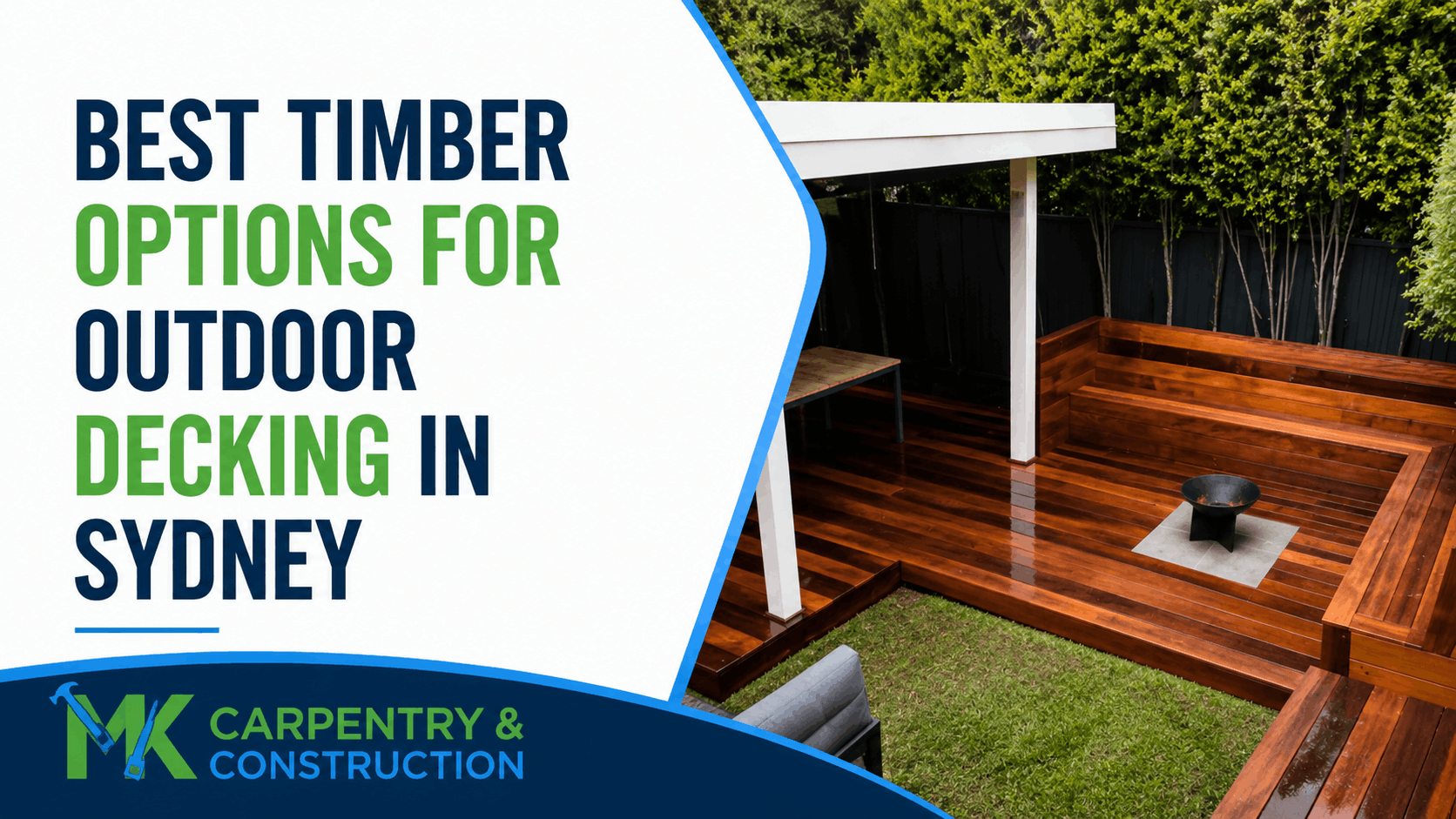
Best Timber Options for Outdoor Decking in Sydney
If you’re planning a new timber deck, one of the first decisions you’ll need to make is what material to use.
A quick search for the best timber for decking in Sydney can leave you with a long list of options, opinions and comparisons.
But there isn’t one timber that is automatically the best choice for every deck.
The right material depends on your property, where the deck will be built, how exposed it is to the weather, the appearance you want, the amount of maintenance you’re comfortable with and your overall project budget.
Timber durability is also influenced by more than the species alone. Moisture, fungi, termites, ultraviolet exposure, construction detailing and ongoing maintenance can all affect how external timber performs over time.
So before choosing your decking based purely on colour or price, it helps to look at the bigger picture.
There Isn’t One “Best” Timber for Every Deck
When homeowners ask what the best decking timber is, the most useful answer often starts with another question:
Best for what?
The best material for a heavily exposed deck may be different from the best choice for a protected outdoor entertaining area.
One homeowner may want a particular natural appearance and be happy to maintain it regularly.
Another may prioritise durability and practicality.
Someone else may be working within a specific budget.
That’s why choosing outdoor decking timber should involve more than comparing a few sample boards.
The material needs to suit the way the finished deck will actually be used.
1. Think About the Appearance You Want
Your deck is usually a significant visual part of the outdoor area, so appearance matters.
Think about how you’d like the finished space to feel.
Are you looking for:
- a warm, natural timber appearance
- something that complements the existing home
- a lighter or darker finish
- a more contemporary outdoor area
- a deck that will blend with existing timber features
- a material that can develop a more weathered appearance over time?
It’s also worth thinking about the house itself.
A decking material that looks great in isolation isn’t automatically the best match for every property.
Consider the exterior colours, surrounding landscaping, existing timberwork and whether the deck will connect directly to an internal living area.
The aim is to choose a material that works as part of the whole property, not just something that looked good in a photograph online.
2. Consider Durability
Appearance is important, but an outdoor deck also needs to perform in an exposed environment.
WoodSolutions, an Australian timber industry technical resource, identifies durability as a key consideration in timber design because external timber can be affected by moisture, fungal decay, termites and UV exposure.
Different timber products can have different durability characteristics, and how a deck is designed and constructed also matters.
Good detailing is important because timber needs to be able to shed water and dry rather than continuously trapping moisture. WoodSolutions specifically notes that durability is not determined by the species or treatment alone.
So when discussing timber deck materials, ask more than:
“How long does this timber last?”
Also ask:
“Is this material appropriate for this particular deck and the conditions it will be exposed to?”
That produces a much more useful conversation.
3. Look at How Exposed the Deck Will Be
Where the deck sits on your property can affect the material decision.
For example, consider:
- whether the deck is completely exposed to rain
- how much direct sunlight it receives
- whether part of it sits beneath a roof or pergola
- ventilation around and beneath the structure
- drainage
- how close the deck is to the ground
- whether moisture is likely to remain trapped around parts of the structure.
Outdoor decks are subjected to weather as well as repeated foot traffic, so effective design needs to account for exposure and drainage.
Close-to-ground decks can require particular attention to factors such as ventilation, drainage, timber durability and termite inspection access.
This is one reason the best material can’t always be selected from a website without considering the site.
4. Be Realistic About Maintenance
Another question worth asking yourself is:
How much maintenance am I prepared to do?
Timber is a natural material, and an outdoor timber deck will be exposed to changing conditions.
Depending on the timber and finishing system selected, maintenance may include:
- cleaning
- checking for deterioration
- recoating or resealing
- replacing damaged components when required
- keeping drainage and ventilation areas clear.
WoodSolutions’ domestic timber deck guidance recommends regular cleaning and notes that decks may need to be resealed or stained at least annually, or according to the coating manufacturer’s instructions.
That doesn’t mean every deck has exactly the same maintenance schedule.
The correct maintenance will depend on the timber, coating, exposure and manufacturer’s recommendations.
The important thing is knowing what you’re signing up for before making a material choice.
If maintaining a particular appearance is important to you, discuss what will realistically be required to keep it looking that way.
5. Consider Your Budget — But Don’t Look Only at the Initial Material Price
Budget will naturally influence your choice.
But comparing decking timber options in Sydney only by the initial price per board can be misleading.
The material is only one component of the completed deck.
Your broader project may involve:
- removal of an existing deck
- preparation of the site
- framing
- fixings
- stairs
- balustrades
- access requirements
- labour
- finishes
- other structural work.
Different material choices may also come with different installation and maintenance considerations.
So rather than asking only:
“Which timber is cheapest?”
consider:
“Which option provides appropriate value for the type of deck we’re building?”
Matthew’s Dream Client research shows this distinction is particularly important for MK Carpentry’s target customer: they are prepared to pay a fair professional rate when they understand why the recommended solution is suitable, what materials will be used and what is included in the project.
6. Think About How You Will Actually Use the Deck
Your deck shouldn’t just look good on completion day.
It needs to work for your everyday life.
Ask yourself:
- Is this mainly an outdoor entertaining area?
- Will children regularly use the space?
- Will you have outdoor furniture or a barbecue on it?
- Is it a main entry or high-traffic area?
- Will it be exposed to full sun?
- Is it being built around an existing feature?
- Are you planning to add a pergola or covered area?
- Do you expect the deck to become an extension of your indoor living space?
The answers help create a clearer picture of what matters most.
For one property, the biggest priority may be appearance.
For another, it may be durability and maintenance.
For another, it may be making an underused outdoor area functional enough that the family actually wants to spend time there.
The material choice should support that outcome.
7. Which Timber Options Does MK Carpentry Recommend?
This is where the recommendation should become specific to the project.
Rather than listing every decking product available and suggesting they’re all materials MK Carpentry uses, the better approach is to discuss the options that are genuinely suitable for:
- the property
- the deck design
- site conditions
- intended use
- appearance you’re trying to achieve
- maintenance expectations
- budget.
MK Carpentry’s own client research identified material selection as one of the questions that can stop homeowners from moving forward. The ideal client doesn’t necessarily want to become a timber expert; they want an experienced professional who can explain the options and why a particular solution is suitable.
That is the role this conversation should play.
You don’t need to research every species before making your first enquiry.
8. Ask These Questions Before Choosing Your Decking Timber
Before making a final material decision, ask your carpenter:
Why do you recommend this timber for my project?
The answer should relate to the property and proposed deck rather than simply personal preference.
What will the finished timber look like?
Ask to see relevant examples where possible.
What maintenance should I expect?
Understand how often the material may need cleaning, finishing or other ongoing care.
How will exposure affect it?
Ask how sun, rain, ventilation and the location of the deck have influenced the recommendation.
Are there other options worth comparing?
There may be more than one suitable solution depending on your priorities.
What is included in the quote?
Make sure the material specification and scope are clear so you understand what you’re comparing between quotes.
9. The Existing Property Matters Too
Decking doesn’t exist independently from the house.
A good material decision should consider how the proposed deck connects with:
- the existing building
- doors and access
- ground levels
- surrounding landscaping
- existing structures
- drainage
- outdoor entertaining areas
- pergolas or covered areas.
Planning requirements may also be relevant depending on the proposed deck and property.
In NSW, certain decks can qualify as exempt development where all relevant development standards are met, while projects outside those requirements may need another approval pathway.
That is another reason it can be worthwhile discussing the whole project before committing to a material.
Choosing the Right Timber Starts With the Right Questions
If you’ve been comparing timber samples and still aren’t sure what to choose, that’s normal.
The best timber for decking in Sydney isn’t necessarily the most expensive option, the most popular option or the one you’ve seen most often online.
It’s the material that makes sense for your deck.
Think about:
How you want it to look.
How the deck will be used.
How exposed the area is.
How much maintenance you’re comfortable with.
What your overall project involves.
Then discuss those priorities with an experienced carpenter before making the final decision.
Planning a New Deck?
MK Carpentry & Construction provides decking services in Sydney, including deck construction and replacement for homeowners wanting to improve their outdoor spaces.
You don’t need to know exactly which timber you want before getting started.
Planning a new deck? Talk to MK Carpentry about your outdoor space, preferred look and practical requirements so you can discuss the right material and next step for your project.