A loose board, sticking door or small area of deteriorating timber can be easy to put off.
If the problem doesn’t feel urgent, it’s tempting to think:
I’ll deal with that later.
Sometimes that’s fine.
But other carpentry maintenance problems can become more difficult, disruptive or expensive if the underlying issue continues to develop.
For homeowners, landlords, investors and property managers, regular maintenance isn’t only about keeping a property looking good.
It’s also about identifying issues early, protecting the condition of the property and preventing smaller problems from turning into larger repair projects.
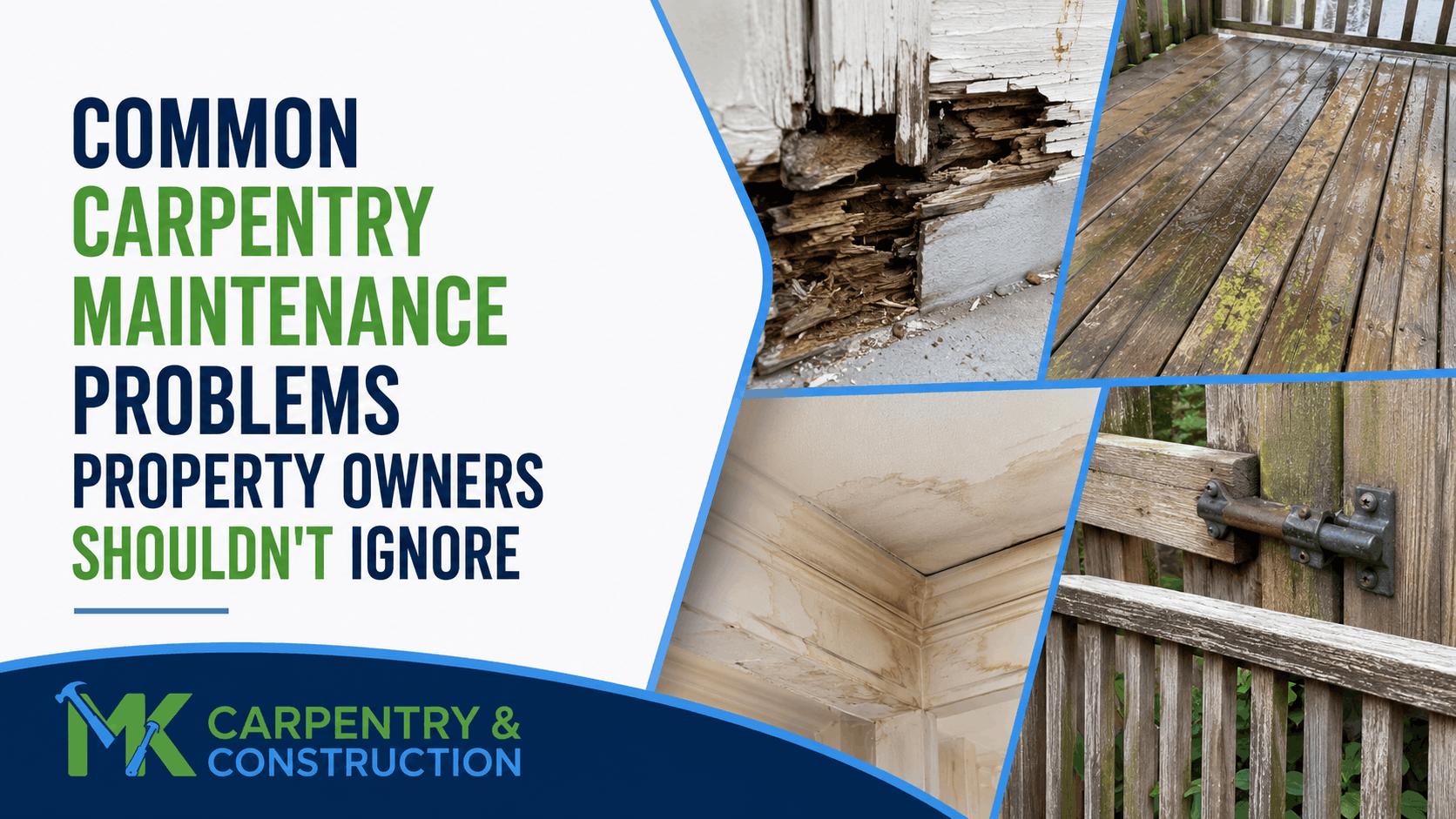
Here are some common carpentry and timber maintenance issues worth paying attention to.
Why Small Maintenance Problems Shouldn’t Automatically Be Ignored
Not every crack, mark or loose fitting means you have a major problem.
But a small visible issue can sometimes be the first sign of something happening underneath.
For example:
- timber deterioration may continue spreading
- moisture may be affecting an area you can’t easily see
- repeated movement may gradually loosen connections
- a damaged fence section may become less stable
- a sticking door may indicate wear, movement or another underlying issue
- a deteriorating deck board may be part of a broader maintenance problem.
The earlier you understand what is causing the issue, the easier it is to decide whether it needs:
monitoring, maintenance, repair or replacement.
You don’t necessarily need to diagnose the problem yourself.
You simply need to notice when something has changed.
1. Deteriorating Timber
Timber is used throughout many Sydney homes and commercial properties.
You may find it in:
- decks
- fences
- pergolas
- stairs
- door frames
- external structures
- trims
- structural elements
- outdoor entertaining areas.
Because timber is a natural material, its condition can change over time depending on exposure, maintenance and how the structure was built.
Signs worth investigating may include:
- soft areas
- splitting
- cracking
- flaking or deteriorated surfaces
- visible decay
- sections that feel less solid than before
- repeated damage in the same area.
A deteriorated surface doesn’t automatically mean an entire structure needs replacing.
But it’s worth understanding how extensive the problem is before simply covering it or carrying out another temporary repair.
2. Loose or Damaged External Structures
Outdoor carpentry has to deal with constant exposure to the elements.
Decks, pergolas, stairs, handrails, fences and similar structures may gradually develop:
- loose components
- movement
- damaged boards
- deteriorating fixings
- weathered timber
- unstable sections.
If you notice movement where there previously wasn’t any, don’t automatically assume it is only a minor cosmetic issue.
There may be a straightforward repair.
But an inspection can help determine whether the problem is isolated or whether other parts of the structure need attention.
This is particularly important for areas people regularly walk on, lean against or use for access.
3. Deck Deterioration
Decks are one of the more obvious areas where maintenance problems can develop.
Common signs include:
- cracked or damaged boards
- loose decking
- soft sections
- movement underfoot
- deteriorating stairs
- loose handrails
- recurring timber damage
- visible deterioration underneath the deck.
If only a small part of the deck is affected and the underlying structure remains in good condition, repair may be possible.
If problems are widespread or involve the supporting structure, a more substantial repair or replacement may need to be considered.
If you’re currently trying to work out which applies to your property, you can also read:
Should You Repair or Replace an Existing Deck?
Internal link: Article #4 – Should You Repair or Replace an Existing Deck?
The important point is not to judge the condition of the entire deck from the surface alone.
4. Fence Damage
A damaged fence can be easy to ignore when it’s still standing.
But over time you may begin noticing:
- leaning sections
- loose palings
- damaged posts
- sections moving in the wind
- rotting timber
- gates no longer closing correctly.
For homeowners, that can affect privacy, security and the appearance of the property.
For landlords and commercial property owners, damaged fencing can also become another maintenance issue requiring repeated tenant or customer follow-up.
Sometimes an isolated section can be repaired.
In other cases, the age and condition of the surrounding fence may mean it is worth considering whether continued patching is still practical.
5. Water-Related Timber Deterioration
Water and timber problems often go together.
That doesn’t necessarily mean the timber itself caused the problem.
There may be another issue allowing moisture to repeatedly reach an area.
You might notice:
- discolouration
- swelling
- softness
- deteriorating edges
- timber that remains damp
- recurring damage after rain
- paint or coatings repeatedly failing in the same place.
If the underlying moisture source isn’t addressed, simply replacing one damaged piece of timber may not solve the problem for long.
That’s why it can be useful to look at the surrounding conditions rather than treating only what is visible.
Depending on the cause, another trade may also need to be involved.
6. Doors, Frames and Other Carpentry Issues
Doors and frames are used every day, so small changes often become noticeable quickly.
You may find that:
- a door starts sticking
- it no longer closes properly
- a latch doesn’t line up
- a frame appears damaged
- timber around the opening has deteriorated
- an external door becomes harder to operate.
Sometimes the solution is straightforward.
But if the same issue keeps returning, it’s worth asking why.
Repeated adjustment may not be the best long-term solution if another underlying problem is contributing to the movement or damage.
The same principle applies to other internal or external carpentry.
If you’re constantly repairing the same thing, it may be time to look beyond the symptom.
7. Repeated Temporary Repairs
A temporary repair has its place.
Sometimes you simply need to make an area functional until a larger project can be completed.
The problem is when a temporary fix quietly becomes the permanent maintenance strategy.
If you’ve repaired the same:
- deck section
- gate
- fence
- timber component
- door
- external structure
several times, ask:
Are we actually solving the problem or just delaying it?
A more comprehensive repair may cost more upfront than another small patch.
But repeated repair work can also add up.
The right decision depends on the condition of the existing structure, how long you expect it to remain in use and whether the repair will genuinely address the cause.
8. Problems Affecting Tenants or Business Operations
Maintenance becomes even more important when you’re managing a rental or commercial property.
A homeowner may be able to tolerate an inconvenient door or damaged fence for a while.
For a property manager, landlord or business owner, the same issue may result in:
- tenant complaints
- repeated maintenance requests
- safety concerns
- interruptions to business operations
- difficulty accessing part of the property
- a poor experience for customers or staff
- additional administrative follow-up.
This is one reason commercial property maintenance in Sydney has different priorities from residential maintenance.
Commercial property owners and managers often need more than someone who can complete the repair.
They need a tradesperson who can:
- understand the issue
- communicate clearly
- provide practical recommendations
- coordinate access
- complete the work properly
- keep them informed.
MK Carpentry’s client research specifically identifies property managers, investors and commercial property owners as a secondary high-value audience requiring reliable ongoing maintenance.
Internal link: Link commercial property maintenance to the Commercial Property Maintenance page.
9. When Can an Early Repair Prevent a Bigger Project?
There isn’t a rule that every small problem becomes a major one.
But maintenance problems generally don’t improve because they have been ignored.
It can be worth investigating earlier when you notice:
- deterioration spreading
- recurring moisture
- increasing movement
- several related components failing
- a repair repeatedly needing attention
- an issue affecting safe use of the area
- damage becoming noticeably worse.
The purpose of early maintenance isn’t to replace everything at the first sign of wear.
It’s to understand the condition of the property while you still have options.
Sometimes the answer may be:
This only needs a relatively small repair.
Other times it may be:
This has reached the point where replacement makes more sense.
Knowing earlier gives you more time to plan.
10. Residential and Commercial Maintenance Aren’t Exactly the Same
The actual carpentry problem may sometimes be similar.
But the customer needs can be different.
A homeowner may primarily be thinking:
I want this repaired properly so I can stop worrying about it.
A property manager may be thinking:
I need someone dependable who can deal with this without me chasing updates for the next two weeks.
A commercial property owner may also need to consider:
- tenant access
- business hours
- customer disruption
- scheduling
- ongoing maintenance
- communication with multiple stakeholders.
This is why MK Carpentry’s website is moving toward separating residential property maintenance from commercial property maintenance rather than treating every maintenance enquiry as the same service. The Deep Dive specifically recommends separating these audiences because their problems, buying process and search intent are different.
Internal link: Link residential property maintenance to the Residential Property Maintenance page.
11. What Should You Send When Requesting an Assessment?
You don’t need to understand exactly what is wrong before contacting a carpenter.
Start with what you can see.
When making an enquiry, it can help to send:
Photos of the problem
Include a wider image showing the surrounding area as well as closer photographs of the damage.
A short description
Explain what you’ve noticed.
For example:
“This section of the fence has started leaning and appears to be getting worse.”
or:
“Several deck boards are deteriorating and we’re unsure what condition the structure underneath is in.”
How long you’ve noticed it
Mention whether the problem appeared recently or has been developing for some time.
Previous repairs
If the same area has already been repaired, say so.
Property type
Let the carpenter know whether the enquiry relates to your home, an investment property, strata or commercial premises.
Access information
For rental and commercial properties, mention any relevant access or scheduling requirements.
You don’t need to diagnose the problem.
The goal is simply to provide enough information for the carpenter to understand what you’re concerned about and determine the appropriate next step.
Don’t Wait for a Small Problem to Become an Urgent One
Property maintenance is easy to postpone because there is always something else demanding attention.
But the best time to investigate a problem is often before it becomes urgent.
That doesn’t mean every worn board needs replacing immediately.
It means paying attention when something changes and getting advice when you’re unsure.
Regular carpentry maintenance in Sydney can help property owners stay ahead of deterioration, understand when repair is practical and make more informed decisions about larger work.
For homeowners, that can mean fewer unfinished jobs accumulating around the property.
For landlords, investors and property managers, it can mean fewer repeated maintenance issues and a clearer process for getting work completed.
Have a Maintenance Issue You’re Unsure About?
MK Carpentry & Construction assists Sydney property owners with carpentry repairs and property maintenance across residential and commercial properties.
You don’t need to know whether the problem requires a small repair or something more substantial before getting in touch.
Have a maintenance issue you’re unsure about? Send through photos and details of the problem and MK Carpentry can discuss the appropriate next step.